Master Local Flower Delivery: Block Dates and Define Zones Natively

You load the van. Rain pours down. You stare at a delivery manifest that makes absolutely no sense. One bouquet goes three blocks away. The next goes to a suburb forty-five minutes in the exact opposite direction. Both customers paid the exact same five-dollar delivery fee at checkout. You just lost money on the second order before you even turned the ignition key.
This scenario plays out in independent floral studios every single day. Floristry demands absolute precision in logistics. Yet, most florists rely on generic checkout carts that treat delicate, water-bound stems like drop-shipped plastic toys. They assume shipping a vase of hydrangeas equals mailing a pair of socks.
To protect your time, your fuel, and your margins, you must ditch the generic settings. You need robust hyper-local delivery logic built directly into your checkout process. You must take absolute command of your calendar, your map, and your daily capacity.
The Chaos of Unrestricted Delivery Settings
When you run a floral studio, geography dictates your profitability. If you fail to dictate where and when you deliver, your customers will dictate it for you. They will select the cheapest option available. They will demand Sunday morning drop-offs when your shop remains closed. They will order a single forty-dollar wrapped bouquet and expect you to drive it across three county lines for free.
The Danger of the Honor System Checkout
Generic e-commerce platforms often force florists into a disastrous "honor system." The checkout page displays a dropdown menu with various delivery fees: "Local ($10)","Extended($20)" and "Out of Town ($35)." The platform relies entirely on the customer to select the correct option honestly.
Customers rarely do. A buyer entering a distant zip code will simply click the ten-dollar "Local" option to save money. The generic system blindly accepts the order and processes the credit card. Now you face a terrible choice. You must absorb the twenty-five-dollar difference, instantly destroying the profit margin on the arrangement. Or, you must make an incredibly awkward phone call to demand more money from a frustrated buyer. Both outcomes damage your business.
The Nightmare of the "Flat Rate"
To avoid the honor system, many florists settle for a flat-rate delivery fee because their website builder offers no alternative. You set a fifteen-dollar flat rate and hope the close deliveries subsidize the distant ones.
This strategy bleeds your bank account dry. Gas costs money. Your driver’s time costs money. Vehicle wear and tear costs money. A flat rate guarantees you lose profit on every single long-distance run. Worse, it alienates your closest, most loyal local customers who feel fifteen dollars seems too steep for a delivery two streets over.
Taking Back Control with Native Delivery Zones
You fix this chaos by defining exact delivery zones natively within your software. You stop asking customers to guess their delivery fee. Instead, you force the system to calculate the fee based on cold, hard geography.
Drawing Boundaries That Protect Profits
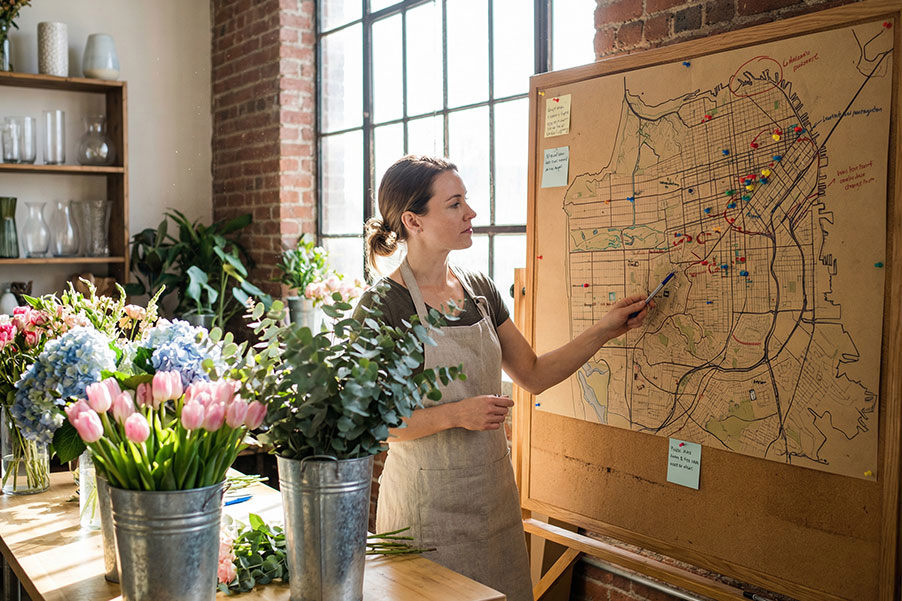
Map out your territory intelligently. Establish a tight radius around your studio for your lowest tier. Draw a second tier for the wider city limits. Design a third tier for the distant suburbs.
When a customer enters their zip code or street address at checkout, specialized floral software instantly matches that location to your predefined zones. It applies the correct fee automatically before the customer reaches the payment screen. The customer cannot argue. They cannot bypass the rule. You secure the exact funds needed to cover the drive, every single time.
Why Zip Codes Fail and Custom Zones Win
Sometimes, zip codes cover massive geographical areas. A single zip code might encompass a dense downtown area and a sprawling, mountainous rural road. Charging the same fee for both locations makes zero logistical sense.
Advanced delivery tools allow you to draw custom shapes directly on a map. You highlight the exact neighborhoods you want to serve. You exclude the neighborhoods that feature terrible traffic or unpaved roads. If a customer tries to place an order outside your drawn boundaries, the system politely stops them. It informs them that delivery remains unavailable for their address. You eliminate out-of-bounds orders entirely.
Mastering the Calendar: Block Dates and Capacity Limits
A functional floral business requires strict time management. You must control your calendar, or the calendar will control you. Generic platforms allow unlimited orders for any given day, leading to catastrophic operational failures.
Surviving Mother's Day and Valentine's Day
Native date blocking saves your sanity during peak seasons. Valentine’s Day arrives. You buy enough premium red roses to design one hundred arrangements. Your team can physically deliver exactly one hundred arrangements.
When you calculate your maximum output, you enter that exact number into your system. The moment order number one hundred hits the database, the software instantly blocks out that date. The calendar date turns gray. Customers can no longer select it. They must choose the day before or the day after.
You eliminate the midnight panic. You fulfill every order perfectly. You sleep soundly knowing your system guarded your capacity. You avoid buying retail flowers at a massive loss just to fulfill orders your system never should have accepted.
Setting Realistic Daily Cut-Off Times
"Same-day delivery" sounds like a fantastic marketing pitch until an order drops into your inbox at 4:45 PM. Your driver already went home. Your cooler looks empty. You scramble to fulfill an impossible promise, stressing your team and risking a sloppy design.
Robust delivery software allows you to establish strict, automated cut-off times. You set the rule: "No same-day orders after 1:00 PM." When the clock strikes 1:01 PM, the system automatically shifts the earliest available delivery date to tomorrow. You train your customers to order early. You remove the daily stress of last-minute scrambles. You keep your team happy and your designs flawless.
Guarding Your Studio's Output
You run a dynamic business. Sometimes, your daily capacity shifts based on external factors. Maybe you booked a massive three-day wedding installation that requires your entire staff. Maybe you want to take a family vacation for a long weekend. Maybe your delivery van blew a tire and sits in the mechanic's shop.
With native date blocking, you manage these curveballs instantly. You just click a button. You black out Thursday and Friday. Customers navigating your site see those dates as completely unavailable. You manage their expectations effortlessly. You avoid the nightmare of canceling orders manually, issuing refunds, and apologizing for system errors. You run your business on your own terms.
Build a Sustainable Floral Logistics Engine
Stop treating your delivery process as an afterthought. Stop relying on generic e-commerce carts that fail to grasp the complexities of perishables, water sources, fragile glass, and ticking clocks.
When you establish strict delivery zones, enforce accurate pricing based on geography, and cap your daily capacity natively, you build a highly sustainable machine. You protect your profit margins from fuel spikes and long drives. You protect your staff from holiday burnout. You deliver a premium, reliable experience to every single recipient.
Take command of your logistics today. Define your boundaries ruthlessly. Block your dates confidently. Sell flowers on your exact terms, and watch your studio thrive.