Price Your Floral Arrangements for Actual Profit, Not Just Revenue

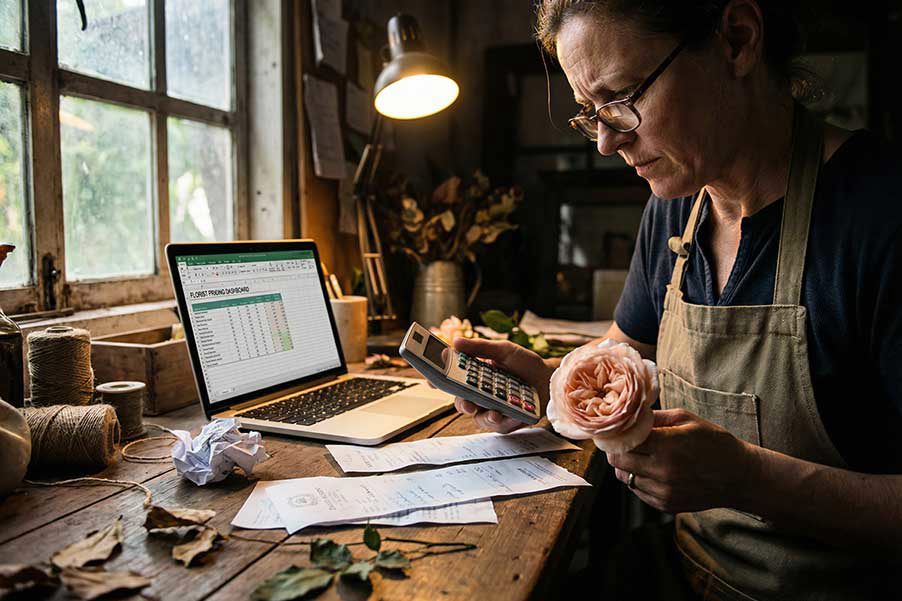
You design a breathtaking, massive floral installation for a Saturday wedding. You spend fourteen hours processing hundreds of stems, bleaching buckets, and assembling complex centerpieces. The client cries tears of joy. You execute the vision perfectly. Then, you sit down on Monday morning, pay your wholesale supplier, pay your freelance designer, and look at your bank account. You realize you made exactly zero profit. In fact, you paid for the privilege of working all weekend.
This silent margin killer destroys independent floral studios every single day. Florists consistently confuse gross revenue with actual profit. You see a large deposit hit your account and assume your business thrives. Yet, when you fail to calculate the exact cost of every single element in your arrangements, your hard work subsidizes your clients' events.
You cannot run a sustainable business on guesswork. You cannot eyeball the cost of a lush bridal bouquet. To survive and scale, you need a precise, mathematical approach. You need a dedicated Pricing Lab to calculate exact stem costs, apply strict markups, and guarantee a healthy margin before you ever send a proposal or list an item on your website.
The Danger of "Gut Feeling" Pricing
Many floral designers suffer from a specific psychological block. You view your work as art. Because you love the medium, you feel guilty charging a premium for it. You look at a vase of hydrangeas, roses, and ranunculus, and you guess a price based on what "feels right" or what you assume your local demographic will pay.
Gut feeling pricing leads directly to bankruptcy. Wholesale flower markets fluctuate wildly. A bunch of white peonies might cost fifteen dollars in May and fifty dollars in November. If you sell a "Designer's Choice" arrangement for seventy-five dollars year-round without adjusting your stem counts to match the wholesale fluctuations, you bleed money for six months of the year.
Copying the Shop Down the Street Guarantees Failure
When florists lack confidence in their own math, they often check their competitors' websites. You see the traditional shop down the street selling a dozen red roses for eighty dollars, so you price yours at seventy-nine dollars to win the order.
This strategy initiates a race to the bottom. You have no idea what the other shop pays for their rent, their labor, or their wholesale product. They might hold a massive volume discount with a South American farm. They might own their building outright. Or, more likely, they might be losing money on that specific eighty-dollar arrangement too. When you copy another business's pricing, you copy their financial mistakes. You must base your prices entirely on your own internal metrics.
Breaking Down the True Cost of a Bouquet
To achieve actual profit, you must dissect your arrangements down to the microscopic level. Every single item that leaves your studio costs you money. You must account for all of it.
Wholesale Stem Costs and the Reality of Spoilage
Start with the obvious: the flowers. You must calculate the exact price per stem. If a bunch of twenty-five roses costs you thirty dollars, each rose costs you one dollar and twenty cents. You must track this number meticulously.
However, novice florists often forget the brutal reality of perishability. Flowers die. Stems snap during design. Botrytis ruins a whole bunch of delicate sweet peas. The industry standard dictates that you must factor in a ten to fifteen percent spoilage rate. If you only calculate the cost of the stems that make it into the final vase, you absorb the cost of the broken ones out of your own pocket. You must build spoilage directly into your base recipe costs.
Hard Goods and Hidden Materials
Vases cost money. But florists often ignore the "invisible" hard goods.
Consider a standard wrapped bouquet. You use a sheet of waterproof cellophane. You add two sheets of premium tissue paper. You tie it off with two yards of silk ribbon. You staple a branded care card to the wrapping. You attach a packet of flower food. You place a branded sticker on the outside.
Individually, these items cost pennies. Collectively, they add two to five dollars to the cost of goods sold (COGS) for every single order. If you sell one hundred bouquets for Mother’s Day and forget to charge for the wrapping materials, you just threw away five hundred dollars of pure profit. You must itemize every piece of wire, tape, foam, and ribbon in your pricing formula.
Factoring in Labor and Operational Overhead
Flowers do not arrange themselves. A vase does not magically fill with fresh water and perfectly spiraled stems. Human hands do the work, and human hands require payment.
The Cost of Your Time
Independent florists routinely commit a massive financial sin: they refuse to pay themselves for their labor. You calculate the cost of the flowers, apply a standard markup, and stop there. You assume the profit margin covers your time. It does not.
Profit exists to grow the business, buy new equipment, and build a safety net. Labor represents a hard cost of doing business. You must charge a specific labor fee for every arrangement you build. Industry standards typically suggest adding a twenty to thirty percent labor charge on top of the retail price of the flowers and hard goods.
Think about the entire process. You spend time emailing the client. You spend time driving to the wholesaler. You spend hours stripping thorns, cutting stems, and bleaching buckets. You spend time designing the piece. You spend time sweeping the floor afterward. The client must pay for that time.
Keeping the Lights On
Your studio consumes resources. Your walk-in cooler runs on electricity twenty-four hours a day. You pay rent for your workspace. You pay insurance for your delivery van. You pay monthly fees for your website hosting and email marketing software.
These expenses represent your operational overhead. While you cannot easily attach a fraction of your electricity bill to a single boutonniere, you must ensure your overall profit margins remain high enough to cover these fixed costs comfortably. If your margins hover around ten percent, one slow month or one unexpected van repair will destroy your cash flow completely.
Applying the Right Markup Formula
Once you identify your exact costs, you must apply rigorous markups. The floral industry relies on specific multipliers to ensure survival.
For fresh flowers and foliage, the standard markup requires multiplying the wholesale cost by three or four. If a stem costs you two dollars, you retail it for six to eight dollars. For hard goods like vases and baskets, you typically multiply the wholesale cost by two or two and a half.
You then add your twenty percent labor charge to the combined retail total of the flowers and hard goods. This final number represents your absolute minimum selling price.
Attempting to do this math with a pencil and a calculator for every single daily order wastes hours of your valuable time. Specialized software handles these formulas instantly. You input your wholesale bunch prices once, build your recipe digitally, and watch the system spit out the exact retail price required to hit your target profit margin.
Protecting Your Margins Year-Round
Wholesale prices change constantly. A severe drought in California or a sudden frost in Ecuador sends the price of specific blooms skyrocketing overnight.
If you publish static prices on your website and refuse to update them, these global events will crush your local margins. You must review your stem costs weekly. When the wholesale price of a specific lily doubles, you have two choices. You raise the retail price of that specific arrangement on your website, or you swap the lily for a more affordable, equally beautiful alternative to maintain your current price point.
You take command of your business when you master your math. You stop working for free. You stop subsidizing your clients' beautiful moments with your own bank account. You build accurate recipes, demand strict markups, and charge unapologetically for your artistry and your labor. When you price for profit, you build a floral brand that lasts.